Gluten Free

Entrée, Fall, Gluten Free, Salad, Side, Spring, Winter

WILD RICE SALAD WITH MISO DRESSING

I've gotten into the habit of keeping some sort of non-lettuce based salad in the fridge, so I have the option to make a smarter lunch or snack choices. While I do enjoy cooking, I don't feel like doing it all the time, so making a big batch of a salad like this, gets me through the lulls. The beauty of a grain salad is that you can pack it full of vegetables, even dress it, and it doesn't go soggy on you. Some days I mix my trusty grain salads in with some lettuce to bulk it up and get more greens. So handy.

The following isn't necessarily an earth shattering combination of asian flavors, but they are all things that hold up well for a few days. Wild rice does take a bit longer to cook than short grain rice, but I find the smoky, nutty flavor unique. The rice, which is actually edible grass, is packed with fiber and other vitamins and minerals. I typically reach for yellow miso, but recently picked up a jar of the white and am loving it's subtlety. You could substitute quinoa or millet or even serve the whole thing warm for dinner if that sounds more appealing. If tofu is not your thing, some shredded chicken or shrimp would be a nice alternative. Now that I've given you just about every option to alter the original, it's time for a bowl of goodness.

WILD RICE SALAD WITH MISO DRESSING // Serves 2 as an entree, 4 as a side

Inspired by the NY Times Recipes for Health

The following makes a decent portion, but if you want it to last you, I would double or triple the amounts. You could get away with less tofu, but increase the amounts of rice and vegetables to ensure leftovers.

1/2 cup wild rice (any rice works, timing will vary accordingly)

14 oz. block extra firm tofu

2 tsp. coconut oil

2 tsp. soy sauce or tamari

fresh ground pepper

1 heaping cup thinly sliced carrots

3/4 cup cooked, shelled, organic edamame

3 Tbsp. toasted sesame seeds

Handful of Chopped Cilantro or Pea Sprouts

// Miso Dressing //

2 Tbsp. white miso

2 Tbsp. agave nectar or brown rice syrup

1 Tbsp. sesame oil

2 1/2 Tbsp. rice vinegar

1 shallot, minced

Juice of half an Orange
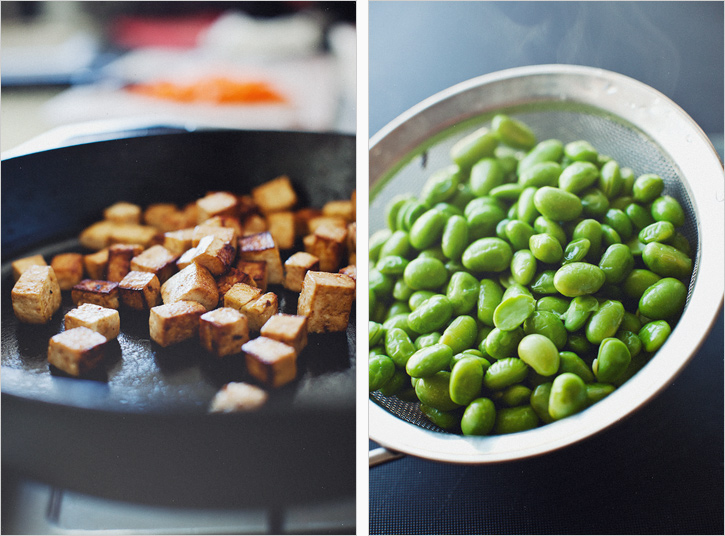
Rinse the wild rice. Bring two cups water to a boil. Add the rice, turn the heat to a simmer, cover and cook until all the water is absorbed (about 35-40 minutes), adding a bit more water if necessary to finish cooking. You will see a tuft of white pop from the center.

Wrap the tofu between a few layers of paper towel or a dish cloth and set it aside to drain for 10-15 minutes. Cut it into a 1/2'' dice. Heat the coconut oil over medium high heat (I love the crust I get in a seasoned cast iron pan). Add the tofu and saute for about five minutes. Sprinkle the soy sauce and a few grinds of fresh pepper over the top and saute another few minutes until the edges are browned. Turn off heat and set aside.

Whisk all of the dressing ingredients together (Don't be tempted to add salt, miso is pretty salty).

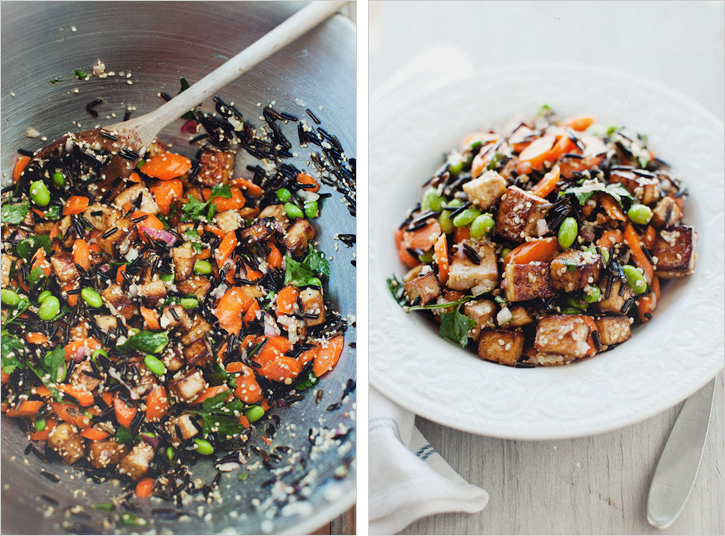
In a large bowl, combine the rice, tofu, sliced carrots, edamame. Toss everything with the dressing. Add the sesame seeds and cilantro and give it another toss. Serve room temperature or chilled.
Print This Recipe

Dessert, Snack, Pantry Staples, Fall, Gluten Free, Winter

PANTRY GOODS: NATURAL SWEETENERS + BAKED APPLES

{Here is the plan: I'd like to try something new around here, every now and then, just to change things up. We'll call it "pantry goods", and I will occasionally dedicate a post to a certain section of a whole foods focused pantry. If you have any positive comments, questions or things you'd like to see around here, please contribute to the comment section!}

I am familiar with the way I cook and eat, but am aware it's not mainstream. For the next few weeks, we're talking "pantry goods", and this post I'm sharing some notes on sweeteners. Forgive me if I am repeating information you already know, but I'm hoping to level the playing field here. It makes me squimish to write as an authority on this, as I have no formal nutrition degree, but I want to share how these natural sweeteners work in my kitchen, and why I find them better choices than plain white sugar. None of these sweeteners are "diet foods" or "low calorie" but I find them to be less processed than the alternative. There are certainly more than what's listed below, but these are what I find in constant rotation around here.

// DRY SWEETENERS //

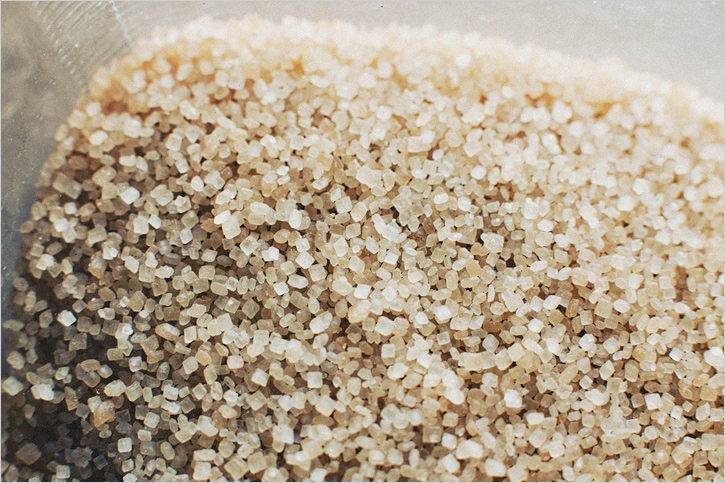
Organic Natural Cane Sugar: This is the closest relative to "plain white sugar", and is defined as pure evaporated cane juice. It retains any natural occuring nutrients and minerals. Plain white sugar is bleached or refined, and clarified by bone char (why some vegans/vegetarians won't eat it). It is easy to find at any conventional market these days.

Muscavado: I use muscavado in place of brown sugar as an equal exchange. Some resources say you should reduce the moisture content a bit, but I find this to be unnecessary. Its texture is moist, much like refined brown sugar, and you can purchase it in light or dark varieties.The flavor is complex and caramel like, making a great substitute in baking. It retains it's natural minerals, as the molasses has never been drawn out of it in the first place. Standard brown sugar is refined, and then the molasses is added back in to make it brown. You can find muscavado at specialty markets, or buy it here.

Turbinado: You know this most popularly as "Sugar in the Raw", they have it in little packets at Starbucks and restaurants, it is a coarse natural cane sugar. It's made by crushing raw sugar cane and pressing out the juice that has all the vitamins and minerals in it. This juice is then dehydrated in a centrifuge to produce larger crystals. It makes an excellent topping to loaf cakes or cookies because it stays crunchy and adds a nice texture. I also like it in granola or a crumble topping because of this. Turbinado is easy to find at a conventional market.

Sucanat: The consistency of sucanat is pretty unique, it resembles sand and it quite dry in texture. It doesn't work in places you need a smooth sweetness, like whipping cream, as it's texture is too dry. It is produced in a similar way to turbinado, except the juice is heated to a syrup, then hand paddled to dry it out. Because it has all of it's natural molasses, it has a good amount of iron, B6, calcium, and potassium. I've read that it is great for homemade bbq sauce, but I use it mostly for baking. My cookies err on the side of "textured" anyway, typically with oats, chocolate chunks and dried fruit, so it fits in perfectly. You can find it at natural food markets or here.

Date or Maple Sugar: Dehydrated versions of their respective ingredients, these sweeteners are considered "whole foods" as there is nothing added or taken away. The maple, for example, is heated and then stirred to dry, sort of like turbinado. They don't dissolve into liquids without heat, but they can be substituted 1:1 for plain or brown sugars. The tastes resemble date/maple with their deep flavor, so use accordingly. You can find them at natural food markets or here. Ashley's cocoa with maple sugar looks delicious.

// LIQUID SWEETENERS //

Honey: Believe it or not, honey does have a season. In the summer and fall, you are going to get the freshest honey when buying it at a local farmers market. Not to say it goes bad, just an interesting note. Bees are essential for our food system, so if you are able to buy it from a local beekeeper, do it. There is usually someone with honey at a farmers market. Honey's unique composition makes it an immunity builder, helps with allergies, anti-microbial, an antioxidant and a remedy for a number of health ailments. It dissolves easily into liquids with a bit of heat and can be used in baked goods. There is a resource through The Honey Locator to find places near you.

Agave Nectar: There are differing opinions on whether agave is as "unrefined" as it is marketed to be. Because it has a high concentration of fructose, some research doesn't find it so great, and with enough googling, you can look into it yourself, I'm not one for conflict. It is extracted from the agave plant, and comes in light, dark and raw varieties. It is said to be lower on the glycemic idex than regular sugar, so it doesn't spike your blood sugar as quickly. It is slightly sweeter than a dry sugar, and doesn't have a strong flavor making it pretty versatile. Because it dissolves easily into a liquid, I often use it in oatmeal, cocktails, dressings, marinades and what not. Agave is easy to find and they have a great price at Costco/Sam's Club if you use it frequently.

Maple Syrup: REAL maple syrup is from the sap of a sugar maple tree. You can purchase it in Grade A or B, the former being a more gentle flavor and the later having a deeper maple-ness to it. I usually go with B, and both are a good source of manganese and zinc. The good stuff can be fairly pricy and since it lasts so long and I use it often, I buy a big jug to save money. I use it as a sweetener for granola and Heidi's peanut butter cookies are spot on.

Brown Rice Syrup: This sweetener is made from fermented brown rice, and then heated to make a thick syrup. It is a complex sugar, which means it is broken down and absorbed more slowly into the blood stream. I use it in granola bars and rice krispy treats, but have read it’s a great sweetener for coffee due to its mild flavor and how well it distributes in liquid with heat. I use it as a sweetener for frozen yogurt in our cookbook and love the gentle flavor it contribute there. You can find is at natural food markets or here.

** Though they all contribute sweetness to a recipe, the dry vs. liquid sweeteners cannot be substituted exactly. As a very general rule, if you want to use a liquid sweetener instead of a dry, you need to scale back the moisture in the recipe back by 1/3 or add 4 Tbsp. of a flour to compensate. If you want to use a dry instead of a liquid sweetener, cup for cup, add 1/3 cup more liquid to the recipe.

Again, all of these notes are based on opinion with some help from Wholesome Sweeteners and SparkPeople.

BAKED APPLES WITH SPICES + NUTS // Makes 4

Adapted from La Tartine Gourmande by Beatrice Peltre

Bea's cookbook, as expected, is quite gorgeous. There are a good amount of dessert recipes along with stunning and creative dishes featuring fresh vegetables. Though not marketed as such, she cooks gluten free, so the recipes call for a few unique flours and such, but they are worth the trip if you don't stock them normally. Sweet stories, thoughtful recipes, the book is a beauty.

I only made a few changes based on the fact that I didn't have vanilla bean or cinnamon sticks on hand, but either way, this is a super easy and tasty dessert.

4 Tbsp. dried cranberries or golden raisins, chopped

4 Tbsp. unsalted pistachios, chopped

4 Tbsp. slivered almonds, chopped

1/2 tsp. cinnamon

1 cup apple juice

1/2 tsp. vanilla extract or one vanilla bean

zest of one lemon

4 apples such as pink lady, winesap, liberty

3 Tbsp. coconut oil, melted

2 Tbsp. turbinado sugar

Preheat the oven to 350'.

Combine the dried fruit, pistachios and almonds in a small bowl. Stir in the cinnamon and set aside.

In a saucepan, combine the apple juice, vanilla extract or seeds of the vanilla bean and lemon zest. Bring it to a simmer for 5 minutes for everything to infuse. Turn off the heat and let it cool.

Core the apples and cut about 1/4 of the top off, reserving the tops (I used a melon baller to scoop out a bit of a pocket in the apple core, this is optional).

Put the apples in an ovenproof dish. Divide the nut stuffing between the apples and cover them with their tops.

Pour the infused juice and oil over the apples and sprinkle with the sugar.

Bake for one hour or until the flesh is tender, regularly drizzling with the cooking juice. Remove from the oven and serve warm with the juices and plain yogurt, whipping cream or ice cream on the side.

Print This Recipe

Appetizer, Entrée, Side, Fall, Gluten Free

BALSAMIC ROASTED ROOTS + SPINACH SAUCE

food photography

Our pastor was talking about his child with Down's Syndrome. He showed videos of him laughing and dancing even when there was no music playing, and in short, relayed what an unexpected source of joy he has been to their family. A child whose condition is thought to be a burden, has enabled every person in their family to take note of the little things. The difference he noted in his sweet three year old boy, is that he feels entitled to nothing and therefore can find joy in anything. My eyes teared, an easy feat actually, but anyone would have, with humility tugging on you throughout his story.

We hear the word "joy" this time of year and we can look right through it. It's a season of sparkly gifts and things, but I want to stay focused on what actually fills me up. It makes me so happy when I come home late from work and Hugh has remembered to plug in the lights around our front door. We don't have a timer and our eyesore of an extension chord is huge and bulky, but the sentiment that my sweet husband plugs them in just for me, fills me with joy. It's in the small things, the unexpected things. And while there will be dissappointment, sorrow and loss, there is also joy when you look for it.

I'm sure you've caught on by now that I am not much for give-aways or product review, but when I was invited to try a few things from Gilt Taste, I made an exception to my self imposed rule. This website has some pretty fabulous artisan food products and is backed by a number of respectable names in the food world. They sent me a CSA-style box filled with some of the most gorgeous vegetables I'd seen in quite a while. So the following is what I came up with from a few of the contents in the box, assisted by a few staples in my pantry and fridge. While there's plenty of flavor on this plate, as is, I could see this as wonderful base for a vegetarian entree, maybe with a tender whole grain added in, or a basic protein of your choice.

food photography

BALSAMIC ROASTED ROOTS + SPINACH SAUCE // Serves 4

As per any recipe I write, you need to trust your gut. The vegetable roasting timing may vary, and the sauce, because it is textured, is forgiving, so alter the flavors as you wish.

1 lb. Assorted Small Carrots

1 lb. Assorted Small Beets

2 Tbsp. Extra Virgin Olive Oil

2 Tbsp. Balsamic Vinegar, divided

1/2 tsp. Sea Salt

1/2 tsp. Black Pepper

1 Bunch Fresh Spinach Leaves

1 Large Clove Garlic, minced

2 tsp. Unsalted Butter

1/2 Cup Light Whipping Cream or Whole Milk

1/3 Cup Finely Grated Parmesan Cheese

1/2 tsp. Prepared Horseradish, optional

Squeeze of Fresh Meyer Lemon Juice

Salt and Pepper to taste

Microgreens for Garnish

food photography
food photography

Scrub the beets and carrots clean. Peel the beets with a vegetable peeler, doesn't have to be perfect. Lay them out to dry on a dishcloth (use a dark one, the beets bleed).

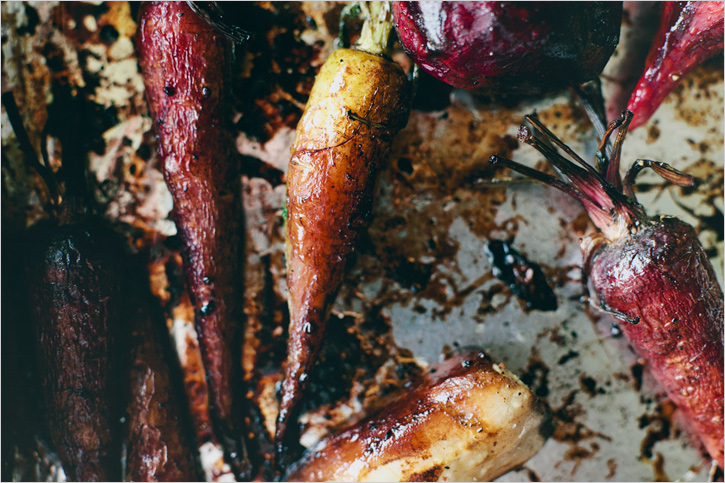
Preheat the oven to 425'. Line a baking sheet with parchment paper or foil. Toss the dry roots in the olive oil, salt and pepper to coat. Sprinkle half the balsamic and toss again. Roast the vegetables on the middle rack anywhere from 30-45 minutes depending on size. You want to be able to pierce a butter knife through the largest vegetable on the tray.

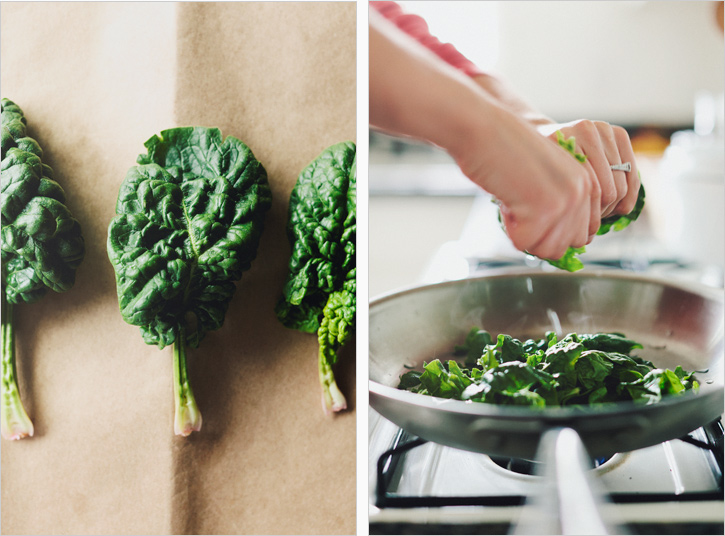
While the vegetables are cooking, make your spinach sauce. Steam the spinach for just a minute or two to cook down. Remove to cool. Squeeze out any remaining water and chop well. You should have about a cup worth.

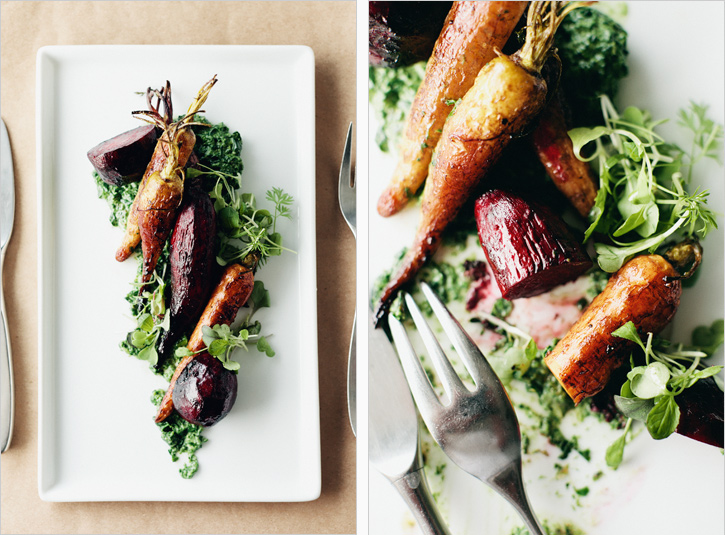
In a medium saute pan over medium low heat, add a drizzle of olive oil and the minced garlic and cook until fragrant, about a minute. Add the butter to melt, stir it around. Add the chopped spinach and cream and stir to coat. Cook until the spinach absorbs most of the cream. Stir in the parmesan, few pinches of salt and pepper, horseradish if using and stir. Using a mini blender or immersion blender, give the spinach a few pulses to break it down. You don't want quite a puree, more of a texture sauce, some chunks are fine. Add it back to the pan and thin with milk/cream if you wish. Squeeze in a bit of fresh lemon juice to taste. Turn off the heat and cover to keep warm. When the vegetables are ready, remove to cool slightly and drizzle on the remaining balsamic. Plate each portion with a schmear of the spinach sauce, the roasted vegetables and microgreens for garnish. Round out the meal however you wish.

* The assorted carrots, beets, spinach, garlic and microgreens were sent to me by Gilt Taste while the text and recipe are my own.

food photography
Print This Recipe